



Best Magnetic Fan for Golf Cart Comfort
The difference between a playable summer round and a miserable one often comes down to airflow. A magnetic fan for golf cart use solves a very specific problem - you need relief from heat without drilling into your cart, dragging around bulky gear, or wasting time on setup before tee-off.
For most golfers, that is the appeal right away. A fan that mounts fast, stays put, and cools the seat area makes more sense than a generic portable fan meant for patios, garages, or strollers. Golf carts move, turn, bounce over paths, and sit under direct sun for hours. If a cooling product is not designed with that use case in mind, it usually shows up in the first nine holes.
What makes a magnetic fan for golf cart use different
The biggest difference is mounting. A magnetic setup removes the hassle of clamps, straps, brackets, or permanent hardware. If your cart has the right metal mounting surface, a magnet-based fan can go on in seconds and come off just as fast when the round is over.
That sounds simple, but it matters more than most buyers expect. Golfers do not want a cooling accessory that becomes another project. If the setup is awkward, if it blocks movement, or if it takes up too much space around the dash or roof supports, it tends to get left at home.
A purpose-built golf cart fan should also account for where the cooling actually needs to go. Good airflow in a garage is not the same as good airflow in an open cart. The fan needs enough output to reach the rider, and the head should be adjustable enough to target the face, chest, or lap instead of just pushing air into open space.
If the fan also includes misting, the difference can be even more noticeable in hot and dry conditions. That said, mist is not always the right choice for every golfer. Some want airflow only. Others want the option to add cooling mist during the hottest stretch of the round and shut it off when humidity is high.
How to choose the right magnetic fan for golf cart setup
The right choice depends on how you use your cart. If you own a private cart and play often in high heat, it makes sense to look for a more complete cooling setup with strong airflow, misting capability, and easy refill options. If you rotate between carts or want something compact enough to carry in and out every round, portability may matter more than maximum output.
Start with fit. Magnetic mounting only works well when the fan is matched to a suitable metal surface and a golf-cart-friendly position. You want a mount that feels secure during normal cart movement, not something that shifts every time the path gets rough or the cart turns sharply.
Then look at power. USB-powered and rechargeable options are popular because they are easy to manage and do not require complicated wiring. That convenience matters for golfers who want a cleaner setup and a faster install. A rechargeable unit also gives you flexibility off the cart, especially if you use it at the range, while walking around the clubhouse, or during tournament wait times.
Battery life is worth checking closely. A fan that performs well for 45 minutes but fades before the back nine is not much help. The better option is a unit that can realistically support a full round based on the speed setting you actually plan to use.
Airflow matters more than fan size
A common mistake is assuming the biggest fan head is automatically the best choice. In a golf cart, usable airflow matters more than raw size. The fan needs to push air where you sit, and it needs to keep doing it while the cart is stopped and moving.
Smaller but better-positioned fans often outperform larger generic fans that were never designed for this environment. A 360-degree adjustable head can make a major difference because it lets you aim the airflow exactly where you need it as sun angle and seating position change throughout the round.
Speed settings help too. Not every hole feels the same, and neither does every climate. A three-speed setup gives golfers more control. You can keep it lower during mild conditions to preserve battery, then bump it up when the afternoon heat starts building.
When misting is worth it
If you play in states where summer rounds feel relentless by the second hole, misting can be the feature that changes the whole experience. Airflow alone helps, but airflow plus a fine mist can bring more immediate relief when direct sun and stagnant heat stack up.
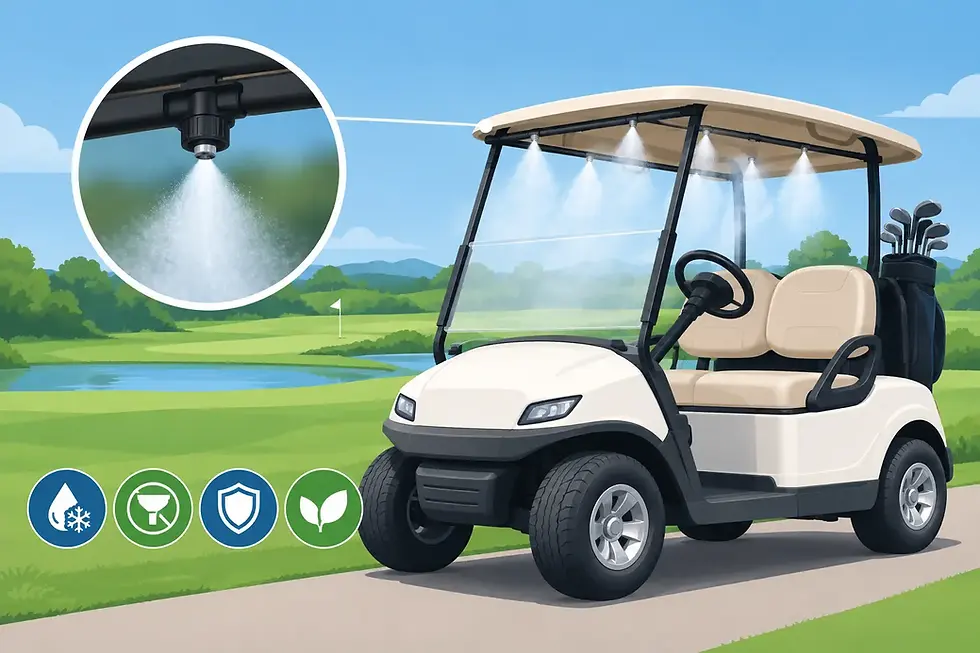
The best misting systems for golf carts are designed to stay practical. That means a lightweight water source, simple hose routing, and nozzles that do not clog easily. It also means you should be able to set them up quickly without turning your cart into a permanent project.
This is where golf-cart-specific design stands apart from generic cooling gear. A compact misting fan with magnetic mounting and a collapsible water bag is easier to carry, store, and remove than larger outdoor systems. It keeps the product useful for real golfers, not just for ideal conditions in a product photo.
Still, misting is not one-size-fits-all. In very humid climates, some golfers prefer stronger fan circulation without adding moisture. Others want both options available depending on weather. Flexibility usually wins.
Portability is not a bonus feature
For many buyers, portability is the deciding factor. A golf cart accessory should not be heavy, awkward, or difficult to stash after the round. If it takes up too much room in the bag well or trunk, it stops being convenient.
That is why compact form factor matters so much in this category. A lightweight fan with magnetic mounting can be installed in under a minute, removed just as fast, and packed away without much thought. That is the kind of product people actually use every weekend.
Portability also matters if you do not always ride the same cart. Some golfers play public courses one week and private facilities the next. Others own a personal cart but still want the flexibility to move their cooling setup elsewhere. A fan that travels well gives you more value because it is not tied to a single cart or permanent installation.
What to avoid when shopping
The biggest red flag is buying a fan that is portable in name only. If it requires too many add-ons, too much assembly, or a questionable mount, it is not solving the problem cleanly.
Another issue is poor adjustability. If the fan cannot aim where you need it, strong airflow numbers on paper do not help much. The same goes for oversized designs that interfere with getting in and out of the cart or take up useful cabin space.
For misting models, avoid systems that look bulky or overly complicated to refill. Golfers want relief, not maintenance. If a unit feels like something built for a backyard deck and then adapted for a cart, it usually lacks the convenience that makes golf-specific cooling worth buying.
Why golf-cart-specific design wins
A magnetic fan for golf cart comfort works best when every feature supports the way golfers actually use carts. Fast installation matters. Compact storage matters. Adjustable airflow matters. Reliable mounting matters. If misting is included, easy water handling matters too.
That is why specialized products tend to outperform generic fans in this category. They are built around the constraints of limited space, open-air seating, changing weather, and the reality that most golfers want a setup they can install and remove without tools. MisterHub focuses on that exact use case, which is why features like magnetic mounting, USB power, collapsible water storage, and golf-cart-specific misting design make practical sense instead of feeling like extras.
A good cooling setup should disappear into the round. You mount it, point it where you want, turn it on, and get on with your game. That is the standard worth shopping for.
If you are choosing your first cart cooling accessory, think less about gadget features and more about friction. The best option is the one you will actually bring, mount, use, and trust every time the forecast turns hot.


Comments