


How Does a Misting Fan Work?
Step onto a golf cart in July and the heat hits differently. The air feels still, the seat is hot, and a standard fan often just pushes warm air around. If you’ve ever wondered how does a misting fan work, the short answer is simple: it combines moving air with a very fine spray of water so heat leaves your skin faster and you feel cooler almost immediately.
That simple idea matters because not all cooling methods feel the same on a golf cart. Shade helps. Airflow helps. Cold drinks help for a minute. But a misting fan is built to create active cooling right where you sit, which is why it can make a long summer round much more manageable.
How does a misting fan work in real use?
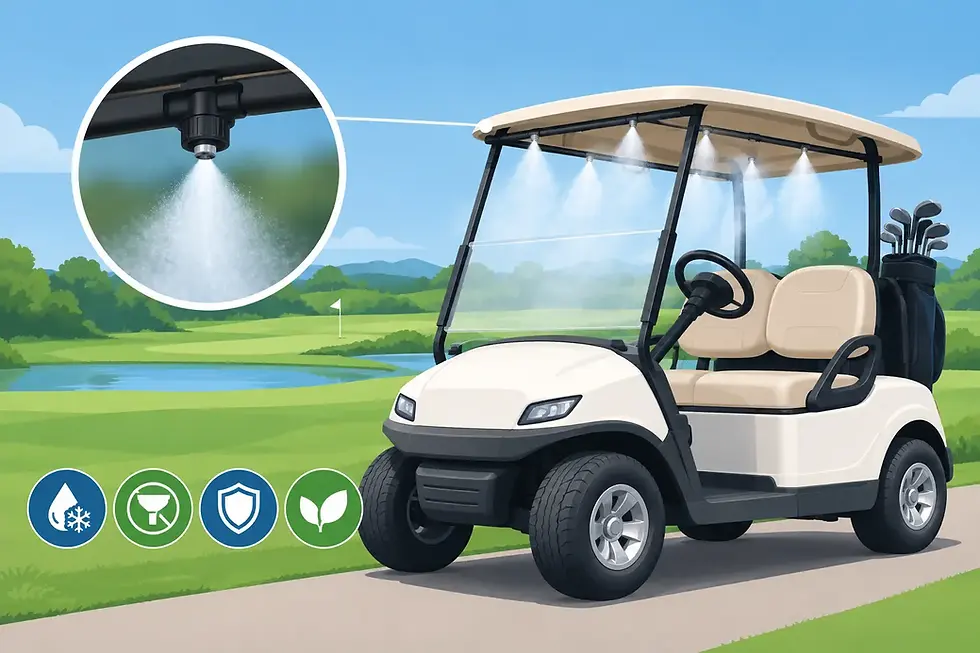
A misting fan does two jobs at the same time. First, the fan moves air across your body. Second, the misting system releases tiny water droplets into that airflow. As those droplets evaporate, they absorb heat from the surrounding air and from your skin. That evaporation effect is what makes the air feel noticeably cooler than a fan alone.
The key is that the water is not meant to soak you. A well-designed unit creates a fine mist, not a spray bottle blast. When the droplets are small enough, they evaporate quickly and produce a cooling effect without leaving your shirt drenched or your cart interior wet.
On a golf cart, that matters more than it does on a patio. You are sitting close to the unit, moving from hole to hole, and you want relief without dealing with puddles, hoses, or permanent hardware. A compact misting fan is effective because it puts cooling right into your personal space instead of trying to cool the entire outdoors.
The three parts that make misting fans work
Every misting fan relies on the same basic system: a fan, a water source, and a way to turn water into a fine mist.
1. The fan creates airflow
The fan blade pulls in surrounding air and pushes it outward. On its own, that airflow can help sweat evaporate faster, which gives some relief. But when outdoor temperatures climb, a fan alone can only do so much. If the air around you is already hot, moving it faster does not always feel like enough.
That is why the misting side changes the experience. The fan carries the mist where you need it and helps speed up evaporation. In practical terms, you feel a cooler stream of air aimed at your face, arms, neck, or chest instead of just warm circulation.
2. The water supply feeds the mist
Most misting fans use a small tank, bottle, reservoir, or water bag. The system draws water from that supply and sends it to the nozzle or nozzles. In a portable setup, the goal is to keep this process simple and lightweight. That is especially important on a golf cart, where bulky tanks and complicated tubing are more trouble than they are worth.
A smaller water supply does mean shorter runtime than a large patio system, but that trade-off usually makes sense for golfers. Portability, quick setup, and easy removal are often more valuable than carrying a large amount of water around the course.
3. The nozzle turns water into fine droplets
This is the part that determines whether a misting fan feels refined or messy. The nozzle breaks water into very small droplets before the fan pushes them outward. Finer droplets evaporate faster and feel cooler. Larger droplets are more likely to land on your skin, clothes, or seat before they evaporate.
That is why nozzle design matters. If the mist is too heavy, the system feels wet instead of cooling. If it is too light, you may barely notice it. A good unit balances droplet size, water flow, and airflow so the mist is visible enough to feel but fine enough to evaporate quickly.
Why evaporation is the whole point
The real cooling power comes from evaporation, not from the water being cold. That is a common point of confusion. You do not need ice water to get relief from a misting fan. Even regular water can create a cooling effect because when water changes from liquid to vapor, it pulls heat from the environment.
Your skin is where you notice this first. The fine mist and moving air help moisture evaporate faster, and that process draws away heat. It works especially well in hot, dry conditions, which is why misting systems feel so effective on many golf courses in the southern and western US.
Humidity changes the equation a bit. In very humid weather, evaporation happens more slowly because the air is already holding more moisture. A misting fan can still feel good, especially with strong airflow and close-range targeting, but the cooling effect may be less dramatic than it is in drier heat. That does not mean the system is not working. It means conditions affect performance.
Why a misting fan feels better than a standard fan on a golf cart
A standard fan can improve comfort, but it has limits when the sun is high and the cart path feels like it is radiating heat back at you. It mainly helps your body use its own sweat to cool itself. If you are already overheated, sweaty, or sitting in stagnant heat, that relief may feel modest.
A misting fan adds a second cooling mechanism. Instead of relying only on your body’s moisture, it introduces a controlled mist into the airflow. That gives evaporation more to work with and usually creates a more noticeable temperature drop in the air stream around you.
For golfers, there is another advantage. You can direct the airflow and mist exactly where you need it. Face, neck, arms, and upper body tend to benefit the most because those areas are exposed and heat up quickly during a round.
What affects how well a misting fan works?
Not every misting fan performs the same way. A few variables have a big impact on real-world cooling.
Fan strength is a major one. Weak airflow can limit how far the mist travels and how fast it evaporates. Stronger airflow usually means better coverage and a more immediate cooling feel.
Nozzle quality matters just as much. A better nozzle produces a finer, more consistent mist and is less likely to clog. That is important in portable systems, where you want dependable performance without constant cleaning or adjustment.
Placement also changes results. On a golf cart, a misting fan works best when it is mounted close enough to target the riders directly. If it is pointed too high or too far outward, some of the cooling benefit gets lost to open air.
Water flow has to be balanced. More water does not always mean better cooling. Too much can create wet surfaces and wasted spray. Too little can make the effect hard to notice. The best systems are tuned to provide enough mist for comfort without creating mess.
Why portability changes the design
A backyard misting setup and a golf cart misting fan solve different problems. Patio systems can rely on larger water connections, permanent mounting, and wider coverage. On a golf cart, that kind of setup is usually overkill.
Golfers need something lighter, faster, and easier to move. The ideal system installs in under a minute, runs off a simple power source, and does not require drilling, plumbing, or a long setup process before tee time. That is why portable, golf-cart-specific designs matter. They are built around convenience just as much as cooling.
This is also where purpose-built features start to matter in practical terms. Magnetic mounting, compact fan housing, rechargeable or USB-powered operation, adjustable nozzles, and anti-clog design are not just product specs. They solve the exact problems golfers care about: getting cool quickly, avoiding hassle, and removing the system just as easily after the round.
Common concerns golfers have
One of the biggest questions is whether a misting fan will get everything wet. A good one should not. You may feel light moisture on your skin, especially at close range, but the goal is fast evaporation and cooling, not a soaking spray.
Another concern is setup. Some cooling products sound good until they involve straps, brackets, adapters, or permanent installation. For most golfers, if it takes too long to mount or remove, it will not get used consistently. Simplicity is part of whether the product works in the real world.
Power and runtime are also practical concerns. Portable units have limits, and that is part of the trade-off for lighter weight and easier transport. The right balance depends on how long you play, whether you want a fixed cart setup or something handheld, and how much gear you want to carry.
If you are choosing a unit for golf, the best question is not just how does a misting fan work. It is how well does it work in a moving cart, in direct sun, with minimal setup, and without turning into one more thing to manage during a round.
That is where design makes the difference. A misting fan is most useful when it feels almost effortless - mount it, fill it, power it on, and get relief right away. For golfers who play in serious heat, that kind of simple cooling is not a luxury. It is what keeps the round comfortable enough to enjoy through the back nine.


Comments