


Misting Fan Versus Regular Fan for Golf Carts
A cart roof can block the direct sun, but it does not do much when hot air is sitting still around the seats. The misting fan versus regular fan decision comes down to one question: do you only need moving air, or do you need the air around you to feel cooler during a long, hot round?
For early tee times, mild heat, or shaded courses, a regular fan can be enough. When the temperature climbs and the cart is parked between shots, misting adds another layer of relief that a standard fan cannot provide. The right choice depends on your climate, how long you play, and how much setup you are willing to tolerate.
How a Regular Fan Cools a Golf Cart
A regular fan cools by moving air across your skin. As air passes over sweat, it helps moisture evaporate, which is your body’s built-in cooling process. That airflow can feel excellent while the cart is moving or when outside temperatures are manageable.
The main advantage is simplicity. A rechargeable or USB-powered fan does not need water, tubing, nozzles, or refills. Turn it on, aim it toward the driver or passenger, and enjoy the breeze. It is also the better fit when you want to keep scorecards, phones, snacks, and cart controls completely dry.
Still, a regular fan has a limit. It does not lower the air temperature. On a 95-degree afternoon, it can feel like someone is blowing 95-degree air at you. That airflow may help, but it often loses its impact when the cart stops near a tee box or while you wait for the group ahead.
When a Regular Fan Makes Sense
A standard fan is a practical option for golfers who play mostly in moderate weather, use a cart only occasionally, or want the smallest possible accessory. It is also useful in high-humidity conditions where mist does not evaporate as quickly. If you already have water, shade, and a steady breeze, a fan may be all you need to stay comfortable.
Regular fans work best when they are easy to position. A fan aimed at your chest or face is more useful than one mounted low in the cart and blowing at your knees. Adjustable angles, stable mounting, and enough battery life for 18 holes matter more than flashy features.
Misting Fan Versus Regular Fan: The Cooling Difference
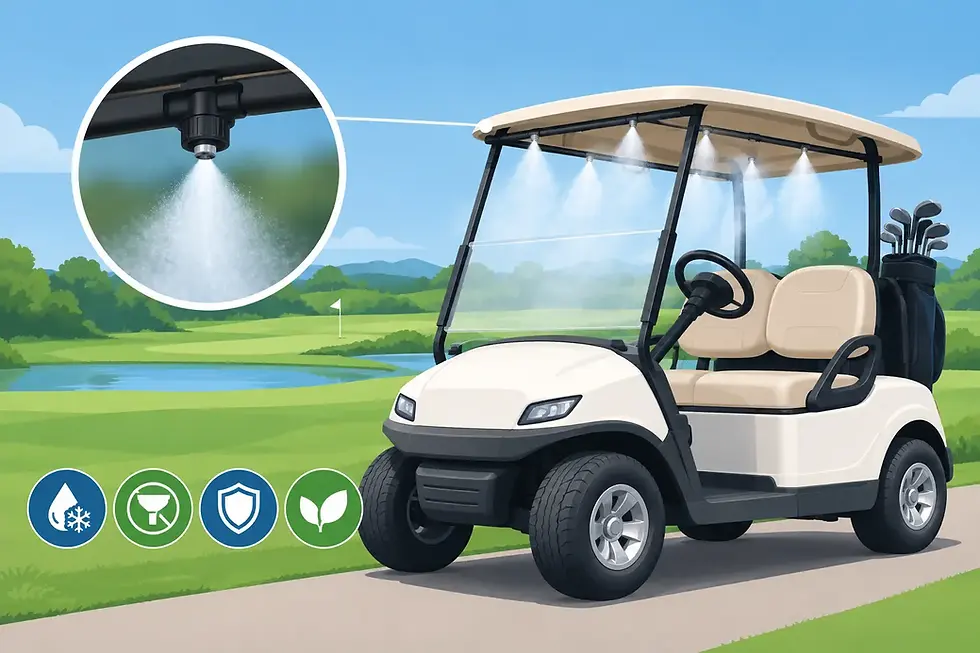
A misting fan combines airflow with a fine spray of water. The fan pushes tiny droplets into the air, and as that water evaporates, it draws heat away from the surrounding air and your skin. This is called evaporative cooling, and it is why mist can feel noticeably cooler than airflow alone.
For golfers, that difference is most obvious on dry, sunny days. A regular fan moves hot air. A misting fan moves air while helping create a cooler microclimate around the cart seats. You may still feel the heat, especially during peak afternoon hours, but the relief can be enough to make the back nine far more manageable.
The trade-off is water. A misting system needs a reservoir or water bag, and it needs to be refilled before it runs dry. It also needs clean water and properly maintained nozzles to produce a fine mist instead of uneven drips. Those are small responsibilities, but they are real ones.
Why Humidity Changes the Result
Misting fans are most effective in dry and semi-dry heat because water evaporates quickly. That makes them a strong choice for many hot-weather golf destinations, particularly where sun and low humidity are part of the regular forecast.
In humid climates, evaporation slows down. A misting fan can still feel refreshing, but the cooling effect may be less dramatic and you may notice more moisture on your arms, clothes, or cart surfaces. In those conditions, use the mist setting as needed instead of running it continuously. A quality fan mode remains valuable when the air is already heavy with moisture.
What Matters on the Course
Golf cart cooling is different from cooling a patio, garage, or backyard chair. You need a system that works while the cart is moving, stays out of the way, and does not require permanent installation. You also need enough runtime to cover a full round without turning your bag into a maintenance kit.
Portability is a major factor for golfers who play different courses or share carts. A fixed system may provide cooling, but it can be inconvenient to move, store, or install. Portable equipment is more practical when it mounts quickly and comes off just as easily at the end of the day.
Mounting location matters, too. Cooling is most useful when it reaches both riders instead of blowing into the windshield or disappearing behind a seat. Magnetic mounting and adjustable nozzles make it easier to aim airflow and mist where you actually sit. That is the difference between having a cooling accessory on the cart and having one that improves the ride.
MisterHub designs portable misting systems specifically around these cart-use details, with fast magnetic attachment, USB power, adjustable spray direction, and water storage that does not require a permanent cart modification.
Consider Water Use Before You Buy
Water capacity affects convenience more than most golfers expect. A tiny reservoir may be fine for a quick nine holes, but it can become frustrating on a long round in intense heat. A larger or collapsible water bag gives you more usable mist time without adding the bulk of a hard tank.
Look for a setup that is easy to refill and easy to carry. You should not have to remove half the system, search for tools, or deal with loose tubing at the turn. If the system uses a water bag, make sure it fits comfortably in the cart without interfering with your feet, clubs, or storage space.
Battery Life and Power Options
Both fan types depend on power. A rechargeable regular fan can be very convenient, but battery capacity determines whether it lasts through 18 holes. Misting fans also need enough power for both the fan and the pump, so runtime deserves close attention.
USB-powered designs are especially useful in golf carts because they can run from a portable battery pack or compatible cart power source. Choose a system with clear speed settings so you can use a lower setting during cooler stretches and save stronger airflow and mist for the hottest part of the round.
Choosing the Best Option for Your Round
Choose a regular fan if you want no water management, play in mild-to-warm weather, or mainly need a personal breeze while driving. It is the simplest answer for golfers who value compact size and dry operation above all else.
Choose a misting fan if you regularly play in direct sun, deal with high temperatures, or find that ordinary airflow stops helping by the middle of the round. It is particularly useful for private cart owners and frequent players who want more than a breeze without installing a permanent cooling unit.
A misting fan is not automatically the better choice for every course and every forecast. On a muggy morning, a regular fan may feel cleaner and more comfortable. On a dry 100-degree afternoon, mist can be the feature that keeps you focused on the next shot instead of counting the holes until the clubhouse.
Get More From Either Fan
Keep the fan or misting unit aimed toward the upper body, where airflow has the greatest effect. Charge batteries before leaving home rather than relying on cart power alone. For misting systems, use clean water and empty the bag after the round if it will sit unused for an extended period.
Avoid spraying directly at phones, scorecards, speakers, or exposed cart controls. A fine mist should cool the riders, not soak the gear. If your system has adjustable nozzles, angle them slightly outward so the mist can mix with the moving air before it reaches you.
Before your next hot-weather tee time, think about when you usually feel the heat most. If a simple breeze gets you through the round, a regular fan keeps things easy. If the cart feels like an oven after the front nine, a portable misting fan gives you a practical way to keep playing comfortably.


Comments